Most O2C automation solutions start at the invoice stage. They assume clean, accurate order data is already in the ERP when the automation begins. The invoice is generated from confirmed order data. Payment terms are applied. Cash is reconciled.
That assumption is wrong for most distribution businesses.
At the typical mid-market distributor, order data doesn't arrive in the ERP clean. It arrives by email, in whatever format the customer chose. Someone reads it, interprets it, looks up the products, and types it in. The O2C cycle begins with manual data entry — and every error introduced at that first step propagates downstream through fulfillment, invoicing, and reconciliation.
Automating the invoice before automating the intake is building the O2C house on a manual foundation.
The 6 stages of the order-to-cash cycle for distributors
The O2C cycle in distribution runs from the moment a customer order arrives to the moment cash is collected:
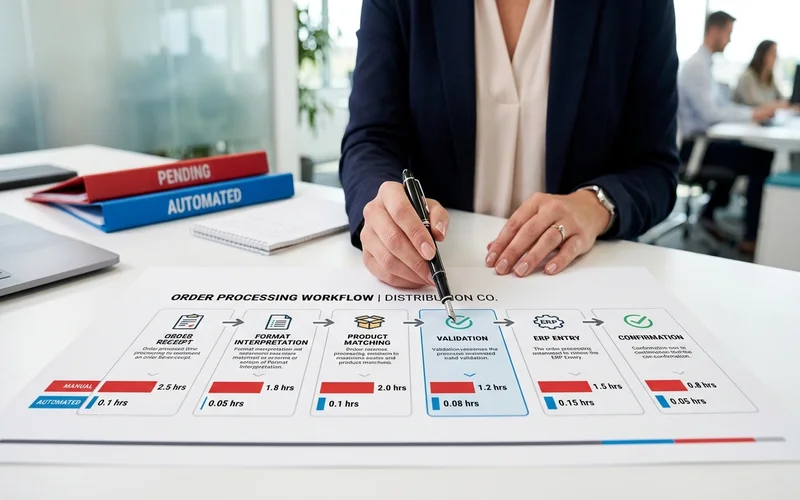
Stage 1: Order receipt and intake. The customer sends an order — by email, PDF, EDI, portal, or phone. The order desk receives it, interprets it, matches products to catalog, and enters it into the ERP as a confirmed sales order. This is the stage most distributors still perform manually.
Stage 2: Order processing and confirmation. The ERP confirms the order, checks credit limits and stock availability, and sends an order acknowledgment to the customer.
Stage 3: Fulfillment and dispatch. The warehouse receives the pick list, picks and packs the order, and dispatches to the customer with a delivery note.
Stage 4: Invoicing. An invoice is generated from the confirmed order data and sent to the customer.
Stage 5: Payment collection. The customer pays against the invoice. Dispute management handles discrepancies.
Stage 6: Cash application and reconciliation. Payment is matched against the open invoice, applied to the customer account, and reconciled in the ledger.
Most O2C automation investment goes into Stages 4 to 6. Invoicing, payment processing, and AR reconciliation are well-served by existing automation tools, many of which are built into or connect to standard ERPs.
Stage 1 is where most distributors are still entirely manual.
Stage 1: Order receipt and intake — where most distributors are manual
Stage 1 is the most labor-intensive stage in the cycle and the one with the most direct impact on the quality of everything that follows. A wrong quantity entered at Stage 1 creates a wrong fulfillment at Stage 3, a disputed invoice at Stage 4, and a payment delay at Stage 5.
The industry benchmark for the fully loaded cost of a single order entry error is $18,000 — including the direct costs of re-shipment and credit notes, and the indirect costs of customer service time and relationship damage. Every error at Stage 1 creates an outsized downstream cost.
Stages 2 to 6: downstream stages that benefit from clean intake
When Stage 1 intake is automated and accurate, every downstream stage operates on better data:
- Stage 2 processing is faster because validated data from Stage 1 requires fewer ERP-level checks
- Stage 3 fulfillment accuracy improves because pick lists are generated from correct order data
- Stage 4 invoicing disputes decrease because invoice data matches what was actually ordered
- Stage 5 payment collection is cleaner because customers aren't disputing invoices for wrong products
- Stage 6 reconciliation is simpler because the reference data trail is accurate
Clean intake is the O2C multiplier. It makes every other automation investment more effective.
Where to start: why intake automation delivers the highest O2C ROI
The upstream-downstream principle
Every O2C automation decision has an upstream-downstream dimension. Upstream automation (intake) creates clean data. Downstream automation (invoicing, payment) processes that data. If upstream data is dirty — wrong quantities, wrong products, wrong pricing — downstream automation processes it wrong and propagates the errors.
Most O2C automation projects start downstream because invoicing and payment tools are more visible to finance leadership, more mature as a technology category, and easier to justify in terms of cash flow efficiency. That's understandable. But it means the errors from manual order intake continue accumulating and creating downstream problems even after the invoice and payment stages are automated.
The ROI calculation changes when you start at intake: not just labor savings at Stage 1, but error cost reductions across Stages 3 to 6, and faster cycle times throughout.
What intake automation looks like in practice
Order processing automation at Stage 1 monitors your email inbox continuously, reads incoming orders in any format, matches products to your catalog using AI interpretation, and pushes confirmed data to your ERP via API. High-confidence orders process automatically. Uncertain items surface for human review before entering the ERP.
The time from order receipt to ERP confirmation drops from 3 to 10 minutes (manual) to under 60 seconds (automated). At 200 orders per day, that's 6,700 staff-hours per year of manual entry time eliminated.
Start Your O2C Automation at the Source
The full O2C automation stack for distributors
Layer 1: Order intake (AI order processing)
This is OrderFlow's layer. It handles the conversion of incoming orders in any format into clean, structured ERP data. The AI reads the email, interprets the order, matches products, scores confidence, and pushes confirmed data to the ERP via API.
For distributors using SAP, Microsoft Dynamics 365, Sage, or NetSuite, this layer connects via standard API and is operational in two to six weeks.
Layer 2 to 3: Order management and fulfillment (ERP and WMS)
Once clean data reaches the ERP at Stage 2, the ERP's order management module handles confirmation, credit checking, and stock reservation. If a WMS (warehouse management system) is in place, the fulfillment workflow routes automatically to the warehouse for picking and dispatch.
For most mid-market distributors, the ERP handles Stages 2 and 3 adequately when data arrives clean from Stage 1. WMS integration becomes relevant at higher fulfillment complexity.
Layer 4 to 6: Invoicing, AR, and collections (ERP and finance automation)
The ERP generates invoices from confirmed order data at Stage 4. Finance automation tools (Esker for invoicing, HighRadius or similar for AR collections) handle Stages 5 and 6 at enterprise scale. For mid-market distributors, ERP-native AP/AR functionality often covers these stages adequately.
What O2C automation looks like when fully integrated
A fully integrated O2C pipeline for a mid-market distributor:
- Order arrives by email at 9:17 AM
- AI processes it by 9:17:45: interprets the order, matches 12 of 13 line items to catalog automatically, flags one uncertain item
- CSR reviews flagged item at 9:18:10: confirms the AI's proposed match, approves
- ERP entry pushed at 9:18:11: 13 confirmed line items enter the ERP via API
- Order confirmation sent to customer at 9:18:12
- Fulfillment triggered automatically when confirmation processes
- Invoice generated from confirmed order data when goods dispatch
- Payment collected against invoice with clean reference data
Total elapsed time: under two minutes, including human review. Against an 8-minute manual baseline, that's 75% time reduction on this order. Across 200 orders per day, the daily elapsed time reduction is measured in hours.
Meesenburg Romania: O2C automation in production
Meesenburg Romania's deployment represents what Stage 1 O2C automation produces in live operations on a real distribution business.
Before automation: each incoming order required manual interpretation, catalog lookup, and ERP entry. For the order desk, Stage 1 of the O2C cycle was the primary time consumer.
After implementing AI order processing automation at Stage 1:
- 98% of orders needed no modification after AI processing. Clean data entered the ERP at Stage 1, improving data quality across all downstream stages.
- 50% of orders completed Stage 1 without human involvement from email receipt to ERP confirmation.
- Order cycle times dropped substantially, accelerating the downstream stages (fulfillment, invoicing) for the majority of order volume.
Banciu Nicolae, General Manager at Meesenburg Romania, confirmed the operational shift. The O2C cycle improvement was visible not just at the intake stage but in fulfillment accuracy and downstream operational efficiency.
For the full ROI framework, including how to calculate intake automation savings versus downstream O2C improvements, see the order processing automation ROI guide.
How to start your O2C automation journey
Phase 1: Automate intake (4 to 8 weeks). Connect an AI order processing layer to your inbox and ERP. This is the highest-ROI phase and the shortest to implement. It produces clean data that makes every subsequent phase more effective.
Phase 2: Connect to downstream O2C automation (3 to 6 months). Add invoicing automation, AR workflow tools, and (if relevant) WMS fulfillment integration. Build on the clean data foundation from Phase 1.
Phase 3: Analytics and continuous improvement (ongoing). With clean O2C data throughout the cycle, your reporting becomes reliable. Order-to-cash cycle time, error rate, automation rate, and cash conversion cycle metrics become actionable.
The complete guide covers Phase 1 in detail — the intake automation implementation sequence from pilot to full deployment.
Book a Demo — Automate Your Order Intake First
Frequently Asked Questions
What is order-to-cash automation?
O2C automation covers the full cycle from receiving a customer order through entry, fulfillment, invoicing, payment collection, and cash application. For distributors, the highest-impact starting point is Stage 1 intake: converting email orders into clean ERP data.
Where should distributors start with O2C automation?
Start at intake. Order intake automation eliminates the most labor-intensive step, creates clean upstream data, and delivers the fastest ROI. Automating invoicing before intake means downstream automation inherits manual entry errors.
How does AI order processing fit into the O2C cycle?
AI order processing handles Stage 1: receiving any incoming format, interpreting what was ordered, matching products, and pushing clean data to the ERP. Every downstream O2C stage operates on that clean input.
What is the ROI of O2C automation for distributors?
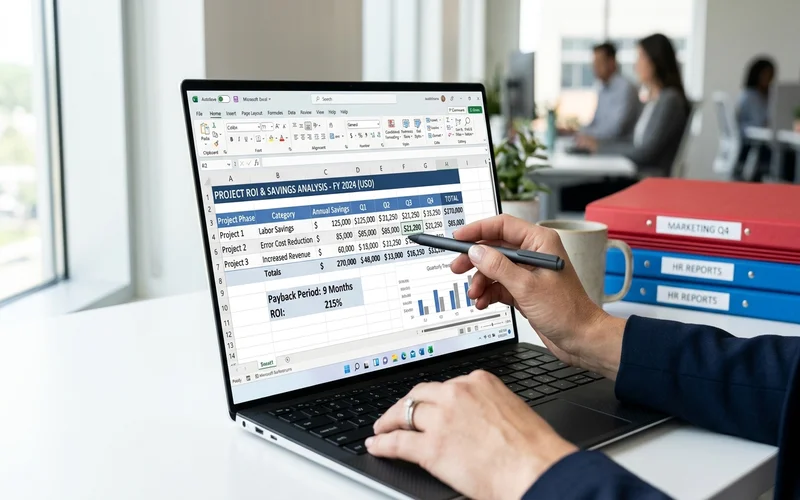
Labor reduction at intake (80 to 95% per order), error cost reduction (downstream errors from manual intake cost $18,000 each in fully loaded costs), and faster cycle times. First-year net savings of $300,000 to $600,000 are typical for distributors processing 200 or more orders per day.
Does O2C automation require replacing our ERP?
No. Intake automation works as an add-on layer. It feeds clean data into your existing ERP via API. Your ERP handles the rest of the O2C cycle unchanged.