Most software comparison lists rank sales order automation tools by features, integrations, and G2 scores. That framing works for general business software. It doesn't work for distribution.
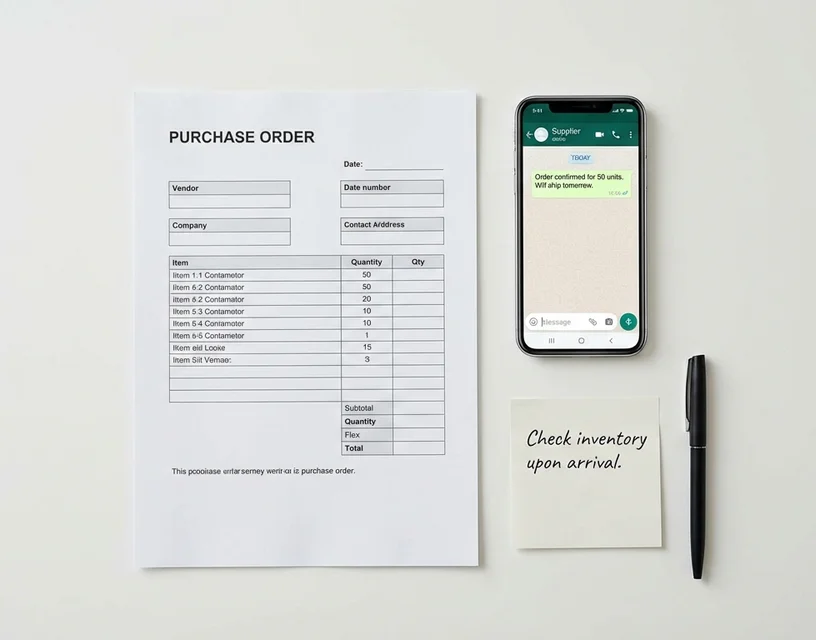
The real test for any order automation tool at a distribution business isn't how it handles a clean PDF purchase order from your three largest accounts. It's what happens when Customer 47 emails at 7:30 AM: "Hi, need the usual fittings, double the 40mm blue ones, and can you check if the gaskets from February are still available?"
No PO number. No product codes. "Usual fittings" pointing to that customer's informal vocabulary. "February" referencing a prior order that may or may not contain what they mean.
Template-based automation fails here. The template needs a structured input to match against. AI-native automation interprets meaning, the same way an experienced CSR would, but across every order that comes in, in seconds.
This comparison covers six sales order automation tools. The ranking is based on one criterion: performance on format variability. Not on demos with clean test data, but on the kind of messy, informal orders that define a real distribution inbox.
What to look for in sales order automation software
Four criteria matter for distribution businesses. Most software reviews skip them.
Format variability handling. Can the system process a free-text email with no product codes, cross-reference your catalog, and produce an accurate ERP-ready line item? This is the hardest capability to evaluate from a vendor demo, because demos use curated test data. Ask vendors to process a sample of your actual inbox, including your most informal customer emails. The accuracy on those samples is the number that matters.
ERP integration breadth. Most tools claim SAP and Dynamics compatibility. The relevant question is which version of your ERP, with which specific connector, in which deployment model. A tool that "integrates with SAP" but requires a three-month custom integration project isn't operationally equivalent to one that ships a pre-built connector. Confirm compatibility in a proof of concept, not in a sales conversation.
Speed to deployment. AI-native tools can typically go live in weeks because there's no template creation process. Legacy platforms require template configuration for each customer format before any orders can automate, which adds months. For distribution businesses operating at margin, every month of manual processing that could have been automated is a real cost.
Human-in-the-loop design. Full touchless automation is the goal for most orders. But for uncertain line items, a well-designed exception queue is essential. The question is how the tool surfaces uncertain items: by flagging the specific line item with a proposed match and confidence score, or by rejecting the whole order for manual re-keying. The first approach scales. The second one doesn't.
The 6 best sales order automation software tools for distributors
1. OrderFlow: Purpose-built for unstructured email orders
OrderFlow was built specifically for the problem other tools leave to manual processing: interpreting unstructured customer communication and matching it to a distribution catalog. The core capability is semantic catalog matching. The system builds an understanding of your product catalog, including customer-specific naming conventions, historical ordering patterns, and variant relationships between SKUs. When a customer describes a product informally, the system reasons about what they most likely mean based on account history and catalog structure.
The practical result is documented from live production operations. At Meesenburg Romania, a multi-category industrial distributor, 98% of orders needed no modification after AI processing. That figure came from their actual inbox, not a controlled test environment. 50% of orders completed end-to-end with no human involvement. The remaining orders went through exception review rather than full re-keying, cutting per-order time substantially across the whole team.
Deployment runs two to six weeks. No per-customer template configuration is required, which means adding a new customer who emails in an unusual format requires no IT involvement. OrderFlow integrates with SAP, Microsoft Dynamics 365, Sage, and other major distribution ERPs via API. Order data is processed and stored in the EU, meeting GDPR data residency requirements.
Best for: Distribution businesses where 40% or more of orders arrive as free-text emails, and where catalog-matching accuracy is the primary bottleneck. Less suited for: Businesses whose entire order intake is structured EDI from a small number of large accounts.
2. Conexiom: Strongest on structured, high-volume formats
Conexiom is a strong tool for one specific case: converting structured purchase orders and EDI documents into ERP-ready sales orders at high volume. If your order intake is dominated by clean PDF POs from a consistent set of trading partners, Conexiom processes them reliably.
The limitation surfaces when formats vary. Conexiom's architecture requires templates for each document format. Building and maintaining templates for 150 customers with different layouts is a real ongoing cost. Templates break when customers change how they order, and each break requires IT involvement to rebuild the mapping. For distributors where most order volume is unstructured, the template maintenance overhead typically outweighs the automation benefit over time.
Pricing runs $30,000 to $60,000 per year for mid-market deployments, with additional costs for template configuration and ERP integration. Implementation timelines run three to six months.
For a detailed breakdown of how Conexiom compares to AI-native tools on format variability and total cost of ownership, Conexiom alternatives covers the specifics.
Best for: High-volume distributors with consistent, structured order formats from major accounts. Less suited for: Businesses with significant free-text email order volume or customers who change their ordering format regularly.
3. Esker: Enterprise AP suite with an order processing module
Esker is an enterprise automation platform covering accounts payable, accounts receivable, and order management. The order processing module handles PDF purchase orders and some unstructured formats, with integrations to major ERPs. But it's a module inside a larger suite, and that shapes the pricing and implementation experience.
For a mid-size distributor whose primary problem is order desk efficiency, Esker is typically over-engineered. The full suite is designed for enterprises that want to consolidate multiple finance workflows onto one platform. If you need the AP and AR modules alongside order management, the calculus changes. If you need the order module only, the cost relative to a purpose-built tool is less favorable, and the implementation is longer because it's scoped as part of a larger platform deployment.
Pricing for mid-market runs $50,000 or more annually. Implementation typically takes four to eight months when deployed within a broader Esker rollout. Esker alternatives covers the comparison for distribution businesses evaluating the order module specifically.
Best for: Enterprise businesses consolidating AP, AR, and order management on a single platform. Less suited for: Mid-market distributors who need order desk efficiency without a full suite deployment.
4. Rossum: Configurable IDP platform for varied document types
Rossum is a horizontal intelligent document processing platform that can be configured for order processing, accounts payable, and other document-heavy workflows. The core technology handles varied document layouts without rigid pre-built templates, which puts it ahead of legacy OCR tools.
The configuration requirement is the key consideration. Rossum isn't distribution-specific out of the box. Getting it to match your catalog, understand your customers' terminology, and connect to your ERP requires implementation work. For a distribution business with a complex catalog and diverse customer base, that configuration scope is significant. Rossum suits environments where document types are reasonably consistent better than inboxes with genuine format variability across hundreds of customers.
Pricing starts around $18,000 per year for basic document processing, scaling by volume and configuration complexity.
Best for: Organizations with well-defined document types who want a configurable platform rather than a turnkey solution. Less suited for: Distributors needing rapid deployment and production-proven accuracy on unstructured email orders.
5. Canals AI: AI-native, EU-focused emerging tool
Canals AI is an AI-native order automation tool built with an EU focus. The approach is similar to OrderFlow in that it uses AI-based catalog matching rather than templates, which means it handles format variability better than legacy platforms. The EU base is relevant for distributors with GDPR data residency requirements.
The main consideration is production evidence. Canals AI is a newer entrant with limited publicly documented deployments from live distribution operations. For a business evaluating software based on production performance data from comparable deployments, the evidence base is thinner than established alternatives. That may change as the product matures and more customer case studies become available.
Best for: EU-based distributors who want an AI-native approach and are comfortable with an earlier-stage platform. Less suited for: Organizations that require extensive production case study evidence before committing.
6. Endeavor AI: Broad manufacturing and distribution platform
Endeavor AI covers a wide range of automation use cases across manufacturing and distribution, including order processing. The breadth is both the selling point and the limitation. As a platform designed for multiple industries, it's not optimized specifically for distribution order desk problems.
For businesses with automation needs across multiple manufacturing workflows, Endeavor's broad platform may be efficient. For a distributor whose primary need is email-to-ERP order accuracy on a complex catalog, a specialist tool delivers more out of the box and requires less configuration to reach production performance.
Endeavor is U.S.-centric in market focus and support infrastructure, which matters for European distributors with GDPR considerations.
Best for: Manufacturers and distributors with automation needs across multiple workflows. Less suited for: European distributors, or those whose primary need is high-accuracy email order processing on an unstructured inbox.
How to choose: the three questions that narrow the field
Three questions cut through most of the complexity in evaluating sales order automation tools.
What share of your orders are unstructured? If 40% or more of your order volume arrives as free-text emails, informal descriptions, or formats that vary by customer, you need AI-native catalog matching. Template-based tools handle the structured minority well and leave the unstructured majority to manual processing. That's often most of your order desk's actual time.
What does your ERP integration actually require? Get a specific answer from each vendor: which version of your ERP, pre-built connector or custom integration, time to connect, IT involvement ongoing. "We integrate with SAP" covers a wide range of actual complexity. A proof of concept that connects to your real system is the only reliable confirmation.
Can the vendor show you accuracy on orders like yours? Ask for a pilot on your actual inbox, not curated test data. A week of real orders, including the most informal ones, run through the system with reviewable output. Any vendor confident in their accuracy on real distribution orders will agree. A vendor who declines is telling you something.
For a deeper framework on evaluating order processing tools, order processing software for distributors covers the pilot structure and what to measure during the first weeks of live operation.
What real implementation looks like: the Meesenburg case
Meesenburg Romania distributes industrial components across multiple product categories. Before automation, their order desk processed each incoming order manually: reading the email, interpreting product references, matching to catalog, entering to ERP, and sending confirmation. It worked. It consumed most of each CSR's day and didn't scale without adding headcount.
After deploying OrderFlow:
- 98% of orders needed no modification after AI processing. The system's catalog matching was accurate enough that the team accepted the AI output without corrections on nearly every order.
- 50% of orders completed end-to-end with no human involvement, from email receipt to ERP entry.
- Exception handling shifted from reactive to proactive. The remaining orders required a confirmation click, not a full re-entry from scratch.
Banciu Nicolae, General Manager at Meesenburg Romania, confirmed the operational shift: his order desk moved from high-volume data entry to reviewing the exceptions the system explicitly flagged as uncertain.
The 98% figure matters not just as a headline number but as an operational confirmation: the system works on real, messy, production distribution orders, not on a demo dataset built to make accuracy look good.
See How OrderFlow Handles Your Order Formats
The right tool depends on what your order inbox actually looks like. If most of your problem is unstructured email volume, the evaluation should start with format variability testing on your real data, not a feature comparison table.
Compare OrderFlow to Your Current Tool — Book a Demo
Frequently Asked Questions
What is sales order automation software?
Sales order automation software receives incoming purchase orders from customers — by email, EDI, portal, or PDF — and converts them into structured ERP-ready sales orders without manual data entry. For distribution businesses, the key capability is handling unstructured formats: free-text emails, informal product descriptions, and orders that don't conform to a template. AI-native tools do this by interpreting meaning; legacy tools do it by matching patterns against pre-built templates.
How much does sales order automation software cost?
Costs vary significantly by approach. Template-based platforms like Conexiom typically run $30,000 to $60,000 per year for mid-market distributors, with additional costs for template creation and maintenance. Rossum starts at $18,000 per year for basic document processing. Esker is part of an enterprise AP suite priced at $50,000 or more annually. AI-native tools like OrderFlow are typically priced per order volume. The total cost of ownership over three years is often lower with AI-native systems because there's no per-customer template work and no IT dependency for format changes.
Which sales order automation software integrates with SAP, Dynamics, or Sage?
OrderFlow integrates with SAP, Microsoft Dynamics 365, Sage, and other major distribution ERPs via API. Conexiom and Esker also support SAP and Dynamics integrations, with Esker having broader enterprise ERP coverage. Rossum connects to most ERPs but requires custom integration work for some configurations. The more important question is whether the integration covers your specific ERP configuration, not just the platform name. A pilot that connects to your actual ERP instance is the reliable way to confirm compatibility before committing.
How long does it take to implement sales order automation software?
OrderFlow is typically operational in two to six weeks from kickoff to live processing. No per-customer template configuration is required, which removes the main source of delay. Conexiom's typical timeline is three to six months, including template creation for each customer format. Esker implementations typically run four to eight months within a larger AP suite deployment. Rossum requires custom model training for each document type, adding several weeks. For distributors who've been through a long implementation project before, the deployment timeline is a genuine differentiator.
What is the difference between EDI and AI-based sales order automation?
EDI requires both trading partners to conform to a shared data standard. It works well for large enterprise accounts who have invested in EDI infrastructure, but excludes most small and mid-size customers who won't or can't adopt it. AI-based sales order automation handles what customers already send — free-text emails, PDFs, spreadsheets, informal messages — without requiring any format change from the customer. For most distributors, EDI covers 30 to 40% of order volume and AI-based automation covers the remaining 60 to 70%. The two approaches are complementary, not competing.