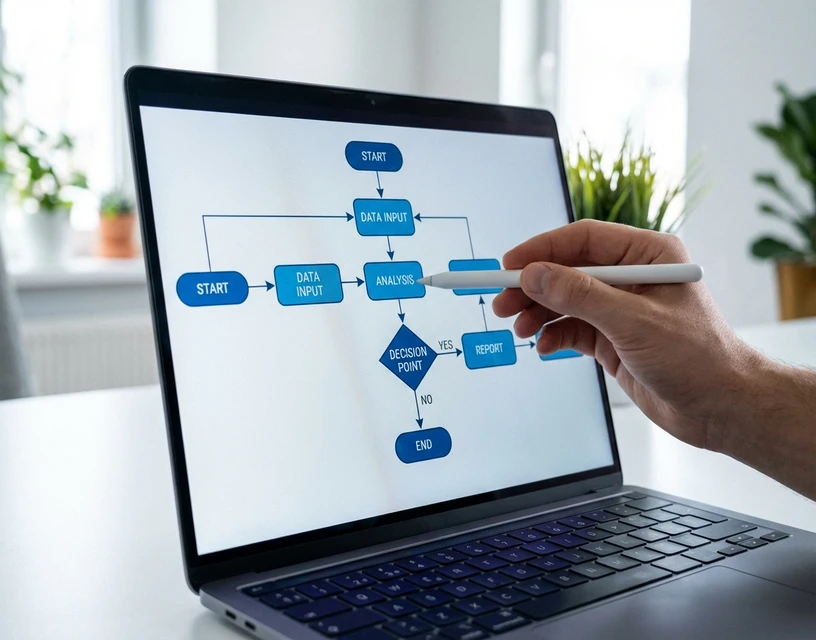
In 2026, "AI-powered" appears on nearly every order management vendor's website. It means something different at each of them. At some, it describes a genuine language model that interprets meaning from unstructured text. At others, it's a marketing rebrand for the same rules engine that's been running since 2015.
The difference matters significantly for distribution businesses. A genuine AI system can read a customer's email that says "need the usual blue fittings, double from last time, and hold the gaskets from March's order" and produce the correct ERP line items. A rules-based system labeled "AI" cannot handle that sentence at all — it fails on novel input.
This guide explains what genuine AI-powered order management means in practice, where it adds real value, and how to tell the difference from AI-washed rule-based automation.
What 'AI-powered' actually means in order management
The marketing version: rules engines called AI
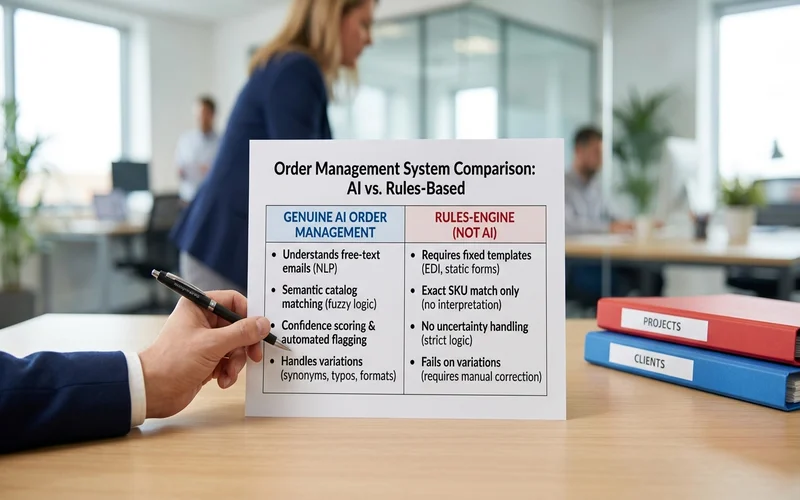
Rules engines have been the backbone of document automation for decades. They extract text from fixed positions in documents, apply pre-configured mappings, and produce structured output when inputs are predictable. They work well when every order arrives in a known, consistent format.
When vendors relabel these systems as "AI-powered," they typically mean the system uses pattern matching with statistical scoring rather than pure deterministic rules. The underlying limitation is the same: novel inputs that don't match known patterns produce uncertain or incorrect output. A customer who changes how they format their orders, or who sends an informal email that the system hasn't been trained on, creates a failure case.
Real AI systems — specifically those using large language models for meaning extraction — handle novel inputs differently. They don't need to have seen a specific format before. They understand the meaning of what was written.
The real version: language understanding and meaning extraction
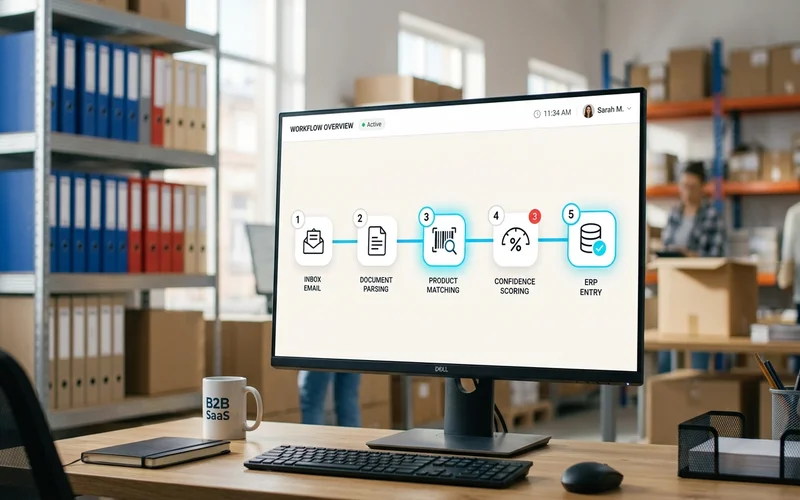
Genuine AI order management uses language models to interpret the content of incoming orders. When a customer writes "same as last week plus 20 more of the DN40 blue," the system:
- Understands that "last week" refers to a prior order (requiring account history access)
- Identifies "DN40 blue" as a product description requiring catalog resolution
- Interprets "20 more" as an additive quantity relative to the prior order
- Resolves the combined instruction into specific line items
That's a reasoning task, not a pattern-matching task. Template systems can't do it. Language models can.
This distinction is why testing AI claims on your actual inbox matters. An AI vendor who declines to process your real orders before a pilot is telling you something about whether their system actually handles the unstructured portion.
Where AI genuinely improves order management for distributors
AI for order intake: reading any order format
The highest-value AI application in distribution order management is intake: reading incoming orders in whatever format they arrive and converting them into structured data. This is where format variability makes template automation unworkable and AI interpretation provides genuine capability.
AI order processing for distributors handles free-text emails, PDF attachments, scanned documents, forwarded threads, and EDI transactions through the same interpretation pipeline. The system reads meaning, not characters. A customer who changes their ordering format doesn't break the pipeline.
AI for catalog matching: understanding informal product names
The second high-value AI application is product matching. Customers use their own vocabulary for products: informal descriptions, abbreviations, nicknames, references to prior orders. An experienced CSR who knows the account resolves these with catalog knowledge built up over years.
AI order management replicates this capability systematically: the system builds a semantic understanding of your catalog and customer-specific naming conventions over time. When a customer uses an informal product name, the system matches it to the correct SKU using catalog context and order history rather than literal text matching.
At Meesenburg Romania, the catalog matching accuracy on live production orders reached 98%. That means the AI's catalog interpretation matched what an experienced CSR would have entered on 98% of order lines.
AI for exception detection: flagging anomalies automatically
AI order management can detect order anomalies that might slip through manual processing: unusual quantities, pricing that doesn't match the customer's contract, duplicate orders, or line items that don't match current stock. These detections run automatically on every order, not just the ones a CSR happens to notice.
The detection produces a specific flag with the AI's interpretation and the anomaly it identified — not a generic rejection. The reviewer sees what the AI detected and decides whether it's a real issue.
AI for learning: improving from corrections over time
When a reviewer corrects an AI-generated line item, that correction can inform future processing. If the AI consistently misidentifies a specific customer's informal product name, the correction builds into the system's understanding of that customer's vocabulary. Over the first weeks of live operation, accuracy typically improves as the system accumulates corrections.
This learning dynamic is part of what makes the 98% accuracy figure achievable in production: the system starts high and improves, rather than starting high in demo conditions and degrading in production.
Where AI is overstated in order management (be honest)
AI doesn't eliminate the human completely — it should amplify them
The 50% full automation rate at Meesenburg Romania means 50% of orders completed without human involvement. The other 50% required a human review step. That's not a failure — it's the design working correctly.
Confident AI decisions proceed automatically. Uncertain decisions get routed to a human with the AI's proposed resolution visible. The human confirms or corrects in seconds. Nothing uncertain enters the ERP without a human seeing it.
A vendor who promises 100% touchless automation is either describing only their most favorable order mix or describing a system that processes uncertain items automatically without flagging them. The second option is more dangerous than manual entry: wrong data enters the ERP without detection. Human-in-the-loop isn't a limitation. It's the quality control layer.
AI needs clean catalog data to work well
AI catalog matching is only as good as the catalog it matches against. If your catalog has thin product descriptions, no alternate names, or significant gaps in customer-specific terminology, the AI produces more uncertain matches than necessary. Improving catalog data before deployment improves accuracy directly.
This is not a major project — enriching the top 200 to 500 products with customer-facing descriptions and common abbreviations typically takes a few days. But it's a real prerequisite that honest AI vendors will tell you about upfront.
How to evaluate whether a solution's AI is genuine
Ask the vendor to process five of your actual emails. Include informal customer communications — not just structured PDFs. Real AI produces matched line items with confidence scores. Marketing AI produces demo screenshots.
Ask what the system does with an order it has never seen before. A real AI system handles novel formats using language understanding. A template system either fails or falls to a catch-all rule. The vendor should be able to describe the mechanism, not just claim the capability.
Ask for named distribution customer references with specific accuracy numbers. "98% no-modification rate at Meesenburg Romania" is verifiable. Generic claims without named customers are unverifiable marketing. Distribution-specific proof matters more than general AI capability claims.
Look for the exception queue. A genuine AI system has a visible, well-designed exception queue that shows confidence scores and proposed matches for flagged items. A system without this is either fully automatic (dangerous) or doesn't have genuine confidence scoring.
See Real AI Order Management in Action
AI-powered order management in practice: Meesenburg Romania
Meesenburg Romania is the reference deployment for genuine AI-powered order management in distribution. The specifics matter:
- Order volume: Significant daily volume across multiple product categories
- Input mix: Structured documents from larger accounts plus unstructured emails from a broad smaller-customer base — the mixed-format inbox that defines most distribution businesses
- Catalog complexity: Multi-category industrial component catalog with thousands of SKUs
- AI result: 98% no-modification accuracy on live production orders. 50% full automation end-to-end.
Banciu Nicolae, General Manager at Meesenburg Romania, confirmed these results from live operations. The system processes the actual inbox — informal descriptions, customer-specific vocabulary, varied formats — and achieves production accuracy that matches what an experienced CSR would enter on 98% of orders.
The how AI processes email orders guide covers the technical pipeline in detail: how the AI reads, interprets, matches, and scores each order before any data reaches the ERP.
What to look for when choosing an AI-powered order management tool
Three questions sharpen the evaluation:
Does the vendor show their system working on your actual orders before a pilot? This is the single most useful test. Any system confident in its AI performance will agree. A decline is informative.
Is the catalog matching genuinely semantic? Ask the vendor to match an informal product description from one of your real customers — one that doesn't contain your product codes. The accuracy on that specific test reflects the catalog matching quality you'll get in production.
Who are the named distribution customers, and what are their specific accuracy numbers? Require specificity. Generic case studies and industry average claims don't predict your specific outcome. Named customers with verifiable results do.
The AI order processing for distributors guide covers the plain-English technical explanation of how the AI interprets orders step by step.
Book a Demo — See What AI Does With Your Messiest Orders
Frequently Asked Questions
What is AI-powered order management?
AI-powered order management uses language models to interpret incoming orders in any format, match them to a product catalog, flag uncertain cases for human review, and push confirmed data to an ERP. It interprets meaning rather than matching templates — enabling it to handle format variability that breaks traditional automation.
How is AI order management different from traditional order automation?
Traditional automation uses templates and rules that work on consistent input and fail on variable input. AI order management interprets meaning regardless of format. A customer who changes how they order doesn't break an AI system.
Does AI-powered order management work with any order format?
Yes. AI order management handles free-text emails, PDFs, scanned documents, EDI, spreadsheets, and forwarded threads without templates. Format variability is handled by default.
What should I look for in an AI order management system?
Format variability handling on your actual emails, catalog matching accuracy on informal product names, confidence scoring with human review for uncertain items, and distribution-specific proof from named customers in live production.
Is AI order management worth the investment for a mid-size distributor?
For distributors processing 100 or more orders per day with significant email volume, typically yes. Labor reduction, error cost reduction, and scalability without proportional headcount produce payback periods of three to twelve months in most deployments.