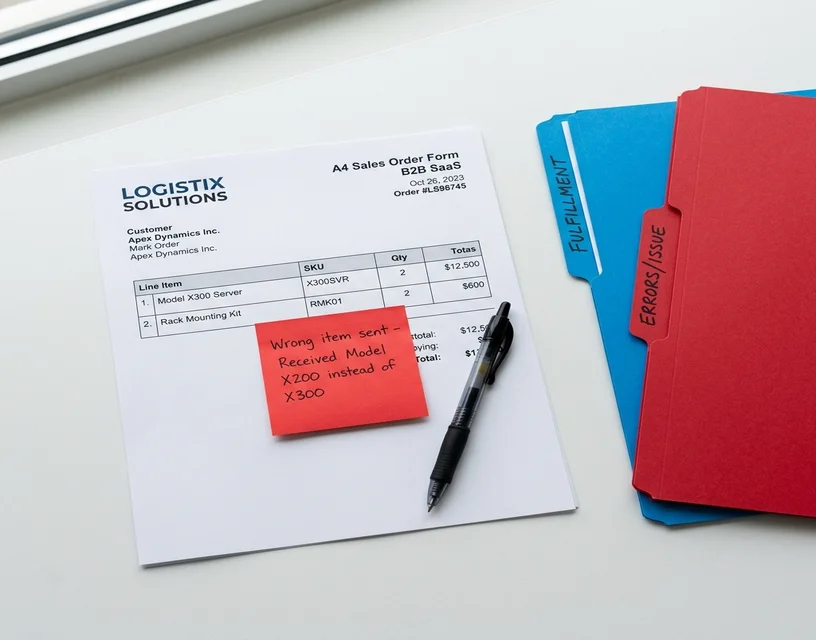
Monday, 8:47 AM. Your inbox: 53 new orders from the weekend. Fourteen are structured PDFs with SKU codes. The other 39 are a mix of plain-text emails, one photo of a handwritten list, and three that just say "same as last time, double the brass fittings."
Your team will spend most of the morning on those 39.
Distribution businesses are generally good at calculating revenue per order. The cost side is harder. But if you've ever watched your labour line grow faster than your order volume, the answer usually lives here.
There are two distinct numbers inside the cost of manual order processing. The first is structural: the labour time your team spends interpreting every single order, whether or not anything goes wrong. The second is error-related: the cost of what goes wrong when an order is misread. Both compound. Most automation vendors lump them together.
This piece separates them. For a deep look at error-specific costs, our analysis of the real cost of sales order errors covers that side. Here, we're focused on the base labour cost of processing every order correctly, every day, by hand.
The Two Costs You Need to Know
Before running any numbers, it helps to understand why these two cost categories need to be treated separately. Error costs are visible: a wrong shipment triggers a complaint, a credit note, a return. Base labour cost for routine processing is invisible. It just shows up in your payroll each month, and it grows every time your order volume grows.
The two categories:
- Base labour cost — time spent by your team correctly processing every order (no errors, no exceptions)
- Error cost — time and money spent resolving processing mistakes after the fact
Both matter. But fixing error costs without addressing base labour costs still leaves you scaling headcount with every growth phase.
Base Labour Cost: The 12-Minute Problem
Industry data puts average manual order processing time at 3 to 12 minutes per order for a trained CSR working on typical B2B distribution orders. The 3-minute figure applies to structured, clean purchase orders with pre-matched SKU codes. Most distribution businesses don't live at the 3-minute end.
If your customers send PDFs with codes that match your catalog, you might average 4 to 6 minutes per order. If they send free-text emails, handwritten notes, or orders referencing "the big valve we use in the boiler room," you're looking at 10 to 15 minutes per order. Your team is doing real interpretation work: figuring out what the customer means, finding the right SKU from a catalog that may have 40,000 items, verifying quantities and units, checking for ambiguity before committing to entry.
At 100 orders per day, 10 minutes per order, and a CSR cost of $25 per hour (a conservative mid-market rate for an experienced order desk rep):
- 100 orders × 10 minutes = 1,000 minutes per day
- 1,000 minutes ÷ 60 = 16.7 hours of labour
- 16.7 hours × $25 = $417 per day in base order processing cost
- $417 × 250 working days = $104,250 per year
And that is one shift. Distributors running 300 orders per day with an average 8-minute processing time are spending closer to $250,000 per year on base manual order processing cost, before a single error occurs.
Format Variability Multiplier: Why Messy Orders Cost More
The 12-minute benchmark deserves a closer look. A standard purchase order from a structured customer might take a trained rep 4 minutes. But many of your customers don't send structured POs.
When an order arrives as a free-text email, three things happen that don't happen with a structured PO:
Interpretation time increases. The rep reads the whole email, not just a table. "Same as last month but skip the O-rings and add 20 of the smaller gasket" takes more cognitive effort than a line-item table. That cognitive effort isn't constant. It scales with complexity.
Error risk increases. The more ambiguous the input, the more judgment calls the rep makes. Each judgment call is a potential error, which connects directly to the second cost category.
Interruption cascades. Ambiguous orders generate calls back to the customer for clarification. A single clarification call takes 5 to 10 minutes and disrupts not just the rep handling it, but the queue behind it.
Most distribution order desks process a mix: some structured customers who send clean POs, some who send free-text emails, a few who send handwritten lists or photos. The free-text segment often represents 20% of customers but 40 to 60% of processing time. That imbalance is where the format variability multiplier lives.
How to Calculate Your Own Order Processing Cost
The formula is straightforward. What's usually missing is someone who has sat down to run it.
The ROI Formula
Step 1: Establish your base labour cost per day
Daily orders × average minutes per order ÷ 60 × hourly CSR cost = daily base labour cost
Example:
- 200 orders per day
- Average 9 minutes per order (blended, including structured and free-text mix)
- CSR fully loaded cost: $28/hour (salary + benefits)
- 200 × 9 ÷ 60 × $28 = $840 per day
- $840 × 250 working days = $210,000 per year in base processing cost
Step 2: Add error cost
At a 3% error rate on 200 daily orders across 250 working days:
- 200 × 0.03 × 250 = 1,500 errors per year
- At $200 direct cost per error: $300,000 per year
- At the $18,000 fully loaded industry benchmark (which includes relationship damage and churn risk): the number is considerably higher
Step 3: Calculate total annual manual processing cost
Base labour + error cost = total annual cost
Using the conservative numbers above: $210,000 + $300,000 = $510,000 per year for a 200-orders-per-day distributor.
That's the true cost of the status quo. Most businesses running this calculation for the first time find it higher than they expected.
When Does Automation Pay for Itself?
The payback calculation depends on what reduces and what stays. AI-based sales order automation eliminates most of the base labour cost for routine orders and drops the error rate toward 1% or below.
Using the same 200-orders-per-day example, if AI handles 70% of orders automatically (a conservative estimate given the real-world data below), the manual processing burden drops to roughly 60 orders per day at full human speed. At 9 minutes per order, that's 9 hours of processing labour instead of 30. Annual base labour cost drops from $210,000 to around $63,000.
Error reduction on the automated orders drops toward near-zero on processed volume, since the AI flags uncertain items rather than passing them through.
Combined savings: $147,000 in base labour, plus a significant reduction in error cost. For most mid-market distributors, payback periods on automation investment fall in the 6 to 18 month range.
Real-World Proof: Meesenburg Romania
Numbers on a spreadsheet are estimates. Meesenburg Romania is not.
Before: Manual Interpretation, 12+ Minutes per Order
Meesenburg, a Romania-based distribution business, was processing email orders manually the same way most distributors do. Each incoming email was triaged, interpreted, matched to catalog, entered in the ERP by a trained rep. The mix of formats they received varied from structured POs to free-text requests to scanned documents, which meant processing time varied widely. Some orders took 5 minutes. Others took much longer when clarification was needed.
The error profile was typical for a team of trained reps: around 3% of orders required correction. Most of those corrections were absorbed into the daily workload as part of "how things work." The cumulative cost of that 3% wasn't being tracked as a line item.
After: 98% No-Modification, 50% Fully Automated
After deploying AI-based order processing:
- 98% of orders needed no modification after AI processing. The AI interpreted the order, matched SKUs to the catalog, and produced ERP-ready data that the team accepted without changes.
- 50% of orders processed with zero human touch, fully automated from email receipt to ERP entry.
- The remaining 50% benefited from AI pre-processing: the team reviewed flagged items rather than re-keying entire orders from scratch.
- Processing time per order dropped toward near-zero for the automated segment. Team time shifted from data entry to review.
Banciu Nicolae, General Manager at Meesenburg, confirmed the operational shift. The error profile went from a 3% bleed across all orders to a fraction of that, concentrated in the flagged items where human judgment was applied before ERP entry.
The Meesenburg case study covers the deployment in detail.
See How OrderFlow Calculates Your ROI — Book a Call
Why Traditional Automation Doesn't Solve the Format Problem
If you've investigated order automation before and been disappointed, there's a specific reason that deserves naming directly.
OCR and template-based systems were built for structured documents. They extract data from a fixed position on a page. When you configure a template for Customer A's PDF format, it works for Customer A's PDF format. When Customer A changes how they send orders, the template breaks. And because no two of your 200 customers send orders the same way, template maintenance becomes a part-time job for whoever owns the integration.
RPA has a similar constraint. It automates keystrokes, replicating what a human does at a keyboard. But it doesn't interpret meaning. A robotic process that automates order entry from structured inputs will still break on "same as last time plus the new gasket size we discussed."
The technical reason AI-based processing is different: it reads meaning, not structure. When the system encounters "same as last time but double the brass 40mm and skip the O-rings," it interprets that as a modification to a prior order, looks up the account's order history, maps "brass 40mm" to the most likely SKU match, flags the O-ring removal, and assigns a confidence score to each element.
No template. No per-customer configuration. When a customer you've never worked with before sends an order in a format the system has never seen, nothing breaks. The AI processes it, assigns confidence scores, and flags anything below threshold for human review. That's how AI processes email orders differently from every automation approach that came before it, and why Meesenburg reached 98% no-modification on real, messy, production data rather than a controlled demo dataset.
If your team handles it fine today, they probably do. But "handles it fine" and "at an acceptable cost" are two different questions. Run the formula in Section 2 with your own numbers. Most distribution managers who do are surprised by what they find.
Frequently Asked Questions
What is the average cost to process a sales order manually?
The fully loaded cost of processing a single order manually ranges from $6 to $25 per order depending on order complexity, CSR labour rate, and the proportion of unstructured formats in your intake. Simple structured POs at an experienced distributor might cost $4 to $8. Free-text email orders, which require interpretation, clarification, and longer entry time, typically cost $12 to $25 per order. At 500 orders per day, the difference in per-order cost adds up to $1 million or more annually.
How does format variability increase manual order processing costs?
Structured POs take 3 to 6 minutes per order. Free-text emails take 8 to 15 minutes. Handwritten notes or photos can take longer still. When 40 to 60% of your order volume is unstructured, your average processing time skews well above the best-case number. Most distributors underestimate their true average because they calibrate against their most efficient customers, not their full intake mix.
What is the ROI of automating order processing for a mid-size distributor?
At 200 orders per day with a 3% error rate, combined base labour and error costs typically run $400,000 to $600,000 per year. Automation that handles 70% of orders automatically and reduces the error rate below 1% cuts that cost by $200,000 to $400,000 annually. Payback periods for mid-market distributors using AI-based processing typically fall between 6 and 18 months.
How long does manual order processing take per order?
Industry averages range from 3 to 12 minutes per order for experienced teams. The low end applies to clean, structured POs from repeat customers with exact SKU codes. The high end applies to free-text email orders requiring interpretation, catalog matching, and sometimes clarification calls. Most distribution businesses average 7 to 10 minutes when accounting for their full order mix.
What is the difference between processing cost and order error cost?
Processing cost is what it costs your team to correctly handle every order, including interpretation, SKU matching, and ERP entry. Error cost is what it costs to fix the orders that were handled incorrectly: wrong SKU shipped, quantity misread, unit confusion. A 3% error rate means 3 of every 100 orders will generate downstream cost regardless of how well your team handles the other 97. Both cost categories live in your P&L. Most businesses only track one of them.
If your team is handling orders manually and you've never calculated what that actually costs, the formula above is a start. Run it with your own order volume, your own error rate, and your own CSR cost. Most managers who do then ask a follow-up question: what does it cost to not change this?