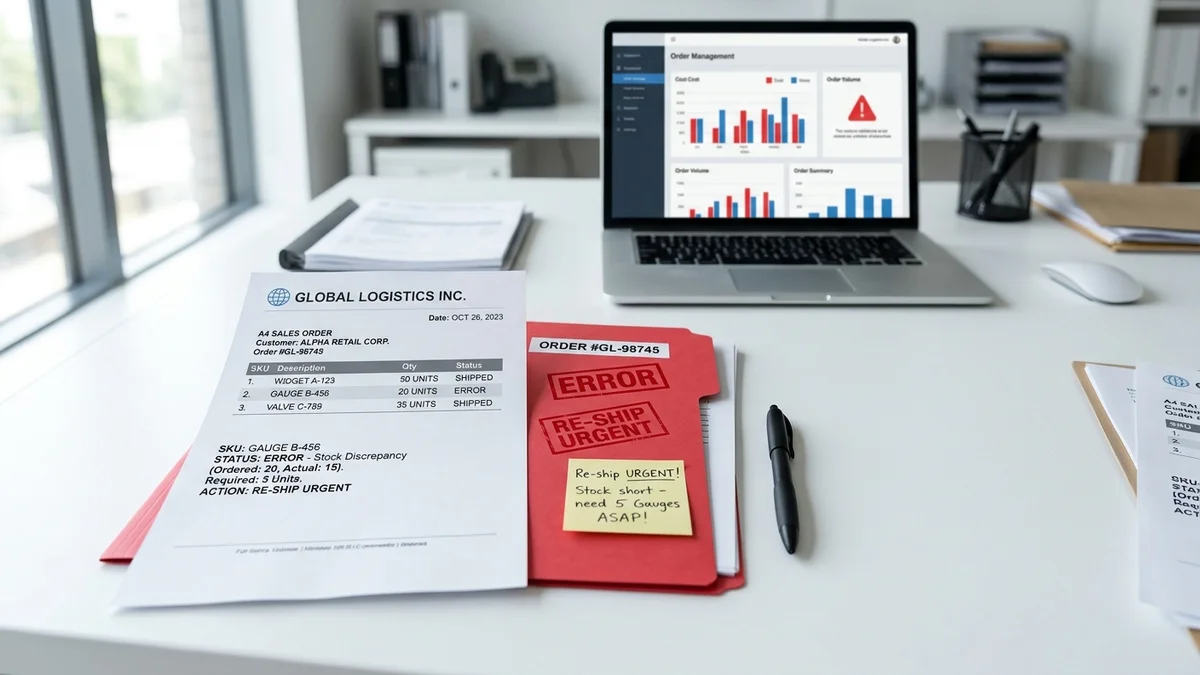
A warehouse ships 40 units of the wrong fitting. The customer service representative spends her morning arranging returns, issuing credits, and expediting corrections. One error cascades into operational disruption and potential customer relationship damage.
This is not a one-off scenario. It is what a 3% error rate looks like in practice — repeated across 300 orders per day, across a 250-day working year. Before calculating what that costs, it is worth understanding why the 3% benchmark understates the real problem, and why the five most common error types cost more than the visible correction work suggests.
The 3% Problem: Why "Acceptable" Error Rates Are Not Acceptable
Industry benchmarks cite a 3% manual order entry error rate for experienced teams. This figure has become a baseline for planning, staffing, and vendor comparisons. The problem is that it masks significant operational impact.
At 300 orders daily with a 3% error rate: this translates to 9 errors per day, or 2,250 annually across a 250-day working year.
The 3% figure reflects only structured PDF purchase orders processed by trained staff. When orders arrive as free-text emails, handwritten notes, or informal WhatsApp messages, error rates climb to 5–8%. For distributors where unstructured orders represent more than 30% of volume — which is typical — the blended rate exceeds 3% before accounting for staff turnover or seasonal volume spikes.
The benchmark is not wrong. It is just measuring the easiest case.
What a Single Order Error Actually Costs
Understanding the true cost of an order error requires separating what your accounting system captures from what it does not.
Direct Costs (Visible)
The identifiable costs of a single error are straightforward to reconstruct: investigation time (30–60 minutes of a CSR's time), customer contact and communication, credit processing, return logistics, and re-shipment. For most distributors, these direct costs total $200 or more per incident before any relationship damage is factored in.
Downstream Costs (Invisible)
The downstream costs are harder to track but often larger than the direct costs:
- Customer confidence erosion — each error shifts a small amount of the customer's trust and willingness to stay with your business
- Supplier reliability score reduction — errors affect how purchasing teams at customer companies rate your reliability in vendor reviews
- Procurement team tracking — for larger customers, repeated errors trigger formal account reassessment processes
Industry research shows that 85% of B2B customers are likely to churn or reduce spending after just three mistakes. The per-error cost calculation has to account for the probability that each error moves a customer closer to that threshold.
Fully Loaded Cost
Research cited by Conexiom places comprehensive error costs at $18,000 when including investigation, correction, relationship damage, and churn probability. A conservative middle estimate that accounts for relationship damage without assuming the worst-case churn scenario: $400–$600 per error as a planning figure for distributors with medium-to-long customer relationships.
The Formula
Daily orders × error rate × cost per error × 250 working days = annual error cost
Example calculations:
- 300 orders/day × 3% × $200 × 250 days = $450,000 annually (direct costs only)
- 300 orders/day × 3% × $500 × 250 days = $1,125,000 annually (blended cost)
These calculations use direct-cost and blended-cost figures respectively. Neither includes the unattributable churn discussed in the hidden costs section below.
The Five Types of Order Errors That Hit Distributors Hardest
Not all order errors have equal cost or equal frequency. Five error types account for the majority of incidents in distribution — each with a distinct mechanism and cost profile.
1. Product Misidentification: Wrong SKU from Informal Descriptions
Customers describe products the way they know them, not the way your catalog organises them. "The blue 40mm fitting," "the standard reducer," "same as last time but the bigger one" — these informal descriptions require a CSR to translate intent into a catalog match from memory or prior order history.
With 30,000+ SKUs common in mid-size distribution, mismatches are frequent and not always caught before shipment. The customer receives the wrong product. The error is discovered at receipt or installation, not at entry.
Cost impact: High — involves returns, re-shipments, expedited replacements, and customer confidence loss. Often requires coordination across warehouse, logistics, and accounts teams.
2. Quantity Errors: Misread Handwriting and Unit-of-Measure Confusion
Handwritten orders introduce ambiguity at the numeral level. A handwritten "12" read as "75," or "2x50" (two packs of fifty) entered as 250 units creates inventory ties, shipping weight discrepancies, complex returns, and accounting ripple effects.
Unit-of-measure errors occur even on typed orders when customer purchasing systems use different units than your catalog. A customer orders in "eaches" when your system tracks the product in "boxes of 12." The math looks correct in isolation and fails at fulfilment.
Cost impact: Variable — occasionally extreme on high-value products or large orders where the unit error multiplies across the full quantity.
3. Missing Line Items: Buried in Free-Text Emails
Four-paragraph emails mixing order details with relationship maintenance, delivery instructions, and questions about next quarter's pricing are a standard format for a significant portion of distribution order intake. CSRs reading quickly under volume pressure miss items mentioned in the third paragraph, or items that appear after a conversational paragraph break.
Longer, more informal emails increase miss rates. The customer's order arrives incomplete. They notice at delivery. The missing items require expedited shipment, often at your cost.
Cost impact: Moderate per incident, high in relationship damage — missing an item signals inattention in a way that a quantity error does not.
4. Customer and Ship-To Mismatches
Distributors serving multi-site customers, buying groups, or accounts with complex procurement structures face a routing problem. Orders from shared email addresses, multiple delivery locations, or division-specific accounts get routed to the wrong entity, triggering cross-charging, re-routing costs, and wrong delivery location arrivals.
For customers operating under group purchasing agreements or consolidated billing, misrouting creates downstream accounting work on both sides of the relationship.
Cost impact: High operational overhead — re-routing in-transit shipments, account reconciliation, potential storage fees if delivery arrives at a location that cannot accept it.
5. Pricing Discrepancies
Customer-specific negotiated discounts, volume tiers, promotional pricing, and catalog updates create complex pricing matrices that change frequently. A CSR entering an order manually applies the pricing they know, which may not match the customer's current agreement.
Errors cut in both directions: pricing that favours the customer erodes margin; pricing that appears unfavourable to the customer damages trust and requires credit notes.
Cost impact: Directly reduces margin on individual transactions. Systemic pricing errors — when the same customer is consistently billed incorrectly — create contract disputes and relationship strain that costs far more than the price differential itself.
The Hidden Costs Nobody Tracks
The five error types above are identifiable because they produce a visible event — a return, a credit note, a complaint. The hidden costs of order errors do not produce a discrete event you can trace to a specific order.
Institutional Knowledge Risk
Experienced CSRs maintain undocumented knowledge that reduces their personal error rate: "Customer 47 always calls the fitting 'the gold one' — it's actually SKU 8840-B." "This account ships to two sites but only bills to one." "This customer's orders always include a courtesy line that is not actually an order item."
This knowledge exists only in the CSR's memory. When that person leaves — through turnover, retirement, or illness — the institutional memory vanishes. New hires make errors the veteran never would, and error rates spike during the ramp-up period. The cost is real and recurring, and it appears as a performance dip rather than an error cost in any reporting.
Customer Churn You Cannot Attribute
The 85% churn statistic cited above operates silently. Customers rarely say "we are reducing our orders because you made three mistakes in the last quarter." They reduce order frequency gradually, shift volume to a secondary supplier without announcement, and eventually consolidate away from you during a procurement review.
The attribution remains impossible: the revenue decline appears as market conditions, competitive pressure, or seasonal variation rather than operational consequence. This is why the $400–$600 blended cost estimate is conservative — it assumes you can identify and prevent the churn that errors cause, which you often cannot.
Opportunity Cost: What Your Team Is Not Doing
Customer-facing CSRs are the point of relationship in distribution. They are the people positioned to flag upsell opportunities, reinforce relationships during contract renewals, and catch signals of changing customer requirements. When 20–30% of their time is absorbed by error correction — investigating, communicating, processing credits, coordinating logistics — that capacity is unavailable for revenue-generating work.
The opportunity cost does not appear in any error cost calculation. It is a structural drain on commercial effectiveness that compounds quietly over time.
Why Traditional Automation Does Not Solve the Error Problem
Three categories of automation are commonly proposed as solutions to order entry errors. Each addresses part of the problem and leaves a significant portion unresolved.
EDI: Only Covers 10–20% of Your Customer Base
Electronic data interchange eliminates errors for the largest trading partners who have the technical infrastructure and IT resources to maintain EDI connections. For most distributors, that means 10–20% of customer relationships — the largest accounts.
The remaining 80–90% of customers continue using email, fax, phone, and informal methods. These are the channels where errors concentrate. EDI investment reduces errors for the customers least likely to produce them and does nothing for the customers most likely to.
OCR and Template Systems: Break When Formats Change
Template-based OCR systems eliminate manual re-keying for document-based orders, which is genuine progress. The failure mode is format dependency: each customer requires a configured template that maps document fields to ERP fields. When a customer changes their document format — a new ERP, a different procurement tool, a revised column layout — the template breaks and manual processing resumes.
Template maintenance overhead increases as the customer base grows. Each format change requires IT involvement. During the gap between format change and template update, errors from manual fallback accumulate. The system also cannot process free-text email orders at all, which excludes a significant portion of distribution order intake from any automation benefit.
RPA: Speeds Up Bad Processes Instead of Fixing Them
Robotic process automation automates keystrokes. It replicates what a human would do at the keyboard — faster and without fatigue, but after the interpretation step that produces most errors has already occurred. If the interpretation is wrong, RPA automates the wrong entry at full speed.
RPA also inherits template dependency: it needs a structured input to work from. Free-text or variable-format inputs require human interpretation first, which means RPA adds no value to the part of the process where errors are most likely.
How AI-Based Order Processing Eliminates Errors at the Source
The difference between AI-based order processing and the automation approaches above is where in the process errors are addressed. Template systems and RPA address the keying step. AI addresses the interpretation step — where most errors originate.
AI-based systems read the full content of an incoming order, regardless of format. Email, PDF, scanned document, handwritten note, WhatsApp message — the system processes the content as text and applies trained understanding to extract structured line items: product, quantity, unit, delivery location, pricing tier.
Confidence Scoring Process
The mechanism that eliminates silent errors is confidence scoring. For each line item extracted, the system assigns a confidence level based on how clearly the source text maps to a catalog match.
- High confidence (above threshold): The item proceeds automatically. The system is certain enough that human review adds no value.
- Low confidence (below threshold): The item surfaces in a human review queue before reaching the ERP. The reviewer sees the original order text alongside the proposed match and the system's reasoning. They confirm or correct, and only then does the item proceed.
The critical distinction from template automation: uncertain items are flagged rather than silently passed. This eliminates the error category that is most damaging — the wrong SKU that ships because no system flagged it as uncertain.
Production Results: Meesenburg Romania
At Meesenburg Romania, a production distributor using AI order processing:
- 98% of orders required no modification after AI processing
- 50% of orders processed with zero human touch — fully automated end-to-end
- Remaining flagged orders confirmed or corrected by the team before ERP entry
- Result: Near-zero silent errors reaching the ERP, and the team's time shifted from re-keying to reviewing the small percentage of genuinely uncertain cases
The 2% that required human attention were not errors — they were uncertain items correctly identified as requiring judgment. The alternative, in a manual or template-based process, is the same 2% going through undetected as silent errors.
Calculate Your Own Error Cost
The framework below uses your own data to produce an annual error cost estimate — and to model what reduction looks like in practice.
Step 1: Establish Baseline
- Daily order volume: ___
- Estimated error rate: ___% (use 3% if untracked; use 5–8% if more than 30% of orders are unstructured email or handwritten)
- Annual errors = daily orders × error rate × 250
Step 2: Assign Cost Per Error
Direct costs: CSR investigation time (hourly rate × 30–60 minutes), credit processing, return shipping, re-shipment. Typical range: $150–$300 per error.
Blended cost (adding relationship damage probability): $400–$600 per error as a planning middle ground for accounts with established customer relationships.
Step 3: Calculate Annual Error Cost
Annual errors × cost per error = annual error cost
Step 4: Factor in Untracked Costs
The formula captures identifiable errors only. Actual cost exceeds the calculation due to:
- Unattributable customer churn (volume reduction that does not trigger a visible event)
- Institutional knowledge risk (error rate increase during staff turnover periods)
- Opportunity cost of team time absorbed by error correction
Add 20–40% to your calculated figure as a conservative adjustment for these untracked costs.
Step 5: Model the Reduction
If AI-based processing reduces your error rate from 3% to under 1%:
- Error count: 2,250 → 750 annually (at 300 orders/day baseline)
- At $200 direct cost: $300,000 saved
- At $500 blended cost: $750,000 saved
At 500 orders/day with a 5% blended error rate (email-heavy intake), the reduction is proportionally larger.
Frequently Asked Questions
What is a normal error rate for manual sales order processing?
Experienced teams on structured PDFs maintain 2–3% error rates. Free-text email orders produce 5–8% errors. Handwritten or photographed orders push higher still. Blended rates exceed 3% when unstructured orders make up more than 30% of volume — which is typical for most distributors.
How much does a single order error cost in distribution?
Direct costs typically exceed $200 per incident. Industry research places comprehensive costs at $18,000 including relationship damage and churn, with typical business planning costs falling between $400–$600 per error depending on customer lifetime value and account complexity.
Can automation completely eliminate order processing errors?
No system eliminates 100% of errors. AI-based processing shifts the error profile to edge cases flagged by confidence scoring for human review. At Meesenburg Romania, 98% of orders needed no modification, with the remaining 2% flagged for human judgment. A flagged uncertain item is not an error. An undetected wrong SKU is.
How long does it take to see error reduction after implementing automation?
Error reduction is typically visible within the first week of production use. The improvement is immediate rather than gradual because the system either interprets the order correctly or flags it for review. Most distributors see error rates below 1% within the first month.
What happens to my order processing team when errors are automated away?
Teams shift to higher-value work: reviewing the small percentage of flagged orders, managing customer relationships, handling exceptions that genuinely require human judgment, and focusing on upselling and account development. At Meesenburg Romania, 50% of orders fully automate while teams review flagged items rather than re-keying entire orders.
If your team is spending time each week correcting order entry errors — tracking down wrong SKUs, processing credits, coordinating re-shipments — that time has a cost that compounds. See how sales order automation eliminates errors at the source, and whether it handles your actual order mix. For the structural labour cost of processing every order manually before any errors occur, see our breakdown of the cost of manual order processing.