Your EDI connection to Siemens works perfectly. Has for years. The order arrives as structured data, maps straight to your ERP, and nobody touches it.
Then there's the email from a plumbing contractor at 6:47 AM: "Need 50 of the same copper fittings as March. Also 3 boxes of the teflon tape, white not yellow. When can you deliver?"
That one sits in the inbox until someone reads it, figures out which copper fittings he means, finds the right SKU, keys it into the system, and confirms. Two different order channels. Two completely different workflows. One automated. One manual. Both landing on the same operations team.
If you're running a distribution business, you know this split. EDI handles the structured partners. Everything else falls on your people. This article breaks down how EDI and AI-based order processing actually compare, where each one fits, and why the answer for most distributors isn't either/or.
The Two-Track Problem: Why Most Distributors Run Parallel Workflows
EDI was built for a specific world: large trading partners with the technical resources to implement standardized data exchange. In that world, it works beautifully. Orders arrive in a defined format, feed directly into your ERP, and require zero manual intervention.
The problem is that most distributors don't live entirely in that world.
What EDI handles well
EDI excels at high-volume, repetitive exchanges between organizations that have agreed on a shared data standard. When both systems speak the same language (ANSI X12, EDIFACT, or a sector-specific variant), the order-to-ERP pipeline is clean. No interpretation required. No ambiguity. This is why EDI remains the backbone of large-scale B2B commerce and why it isn't going anywhere.
The 40-70% of orders EDI never touches
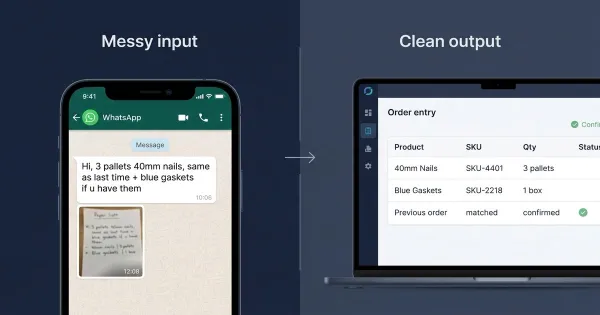
But EDI requires adoption on both ends. Your customer needs the technical infrastructure, the willingness to implement, and the order volume to justify the setup cost. For many mid-market distributors, only 30-60% of customers meet that bar. The rest send emails. PDFs. WhatsApp messages. Faxes. Phone calls that get transcribed into notes. Photos of handwritten lists.
These customers aren't being difficult. They're ordering in the way that's fastest and most natural for them. And they represent a large share of your revenue.
The real cost of two parallel workflows
Running two order workflows means staffing for both. Your EDI orders flow through untouched. Your non-EDI orders go to a team of CSRs who read, interpret, match to catalog, and key into the ERP manually. That team's size scales linearly with your non-EDI volume. Their error rate (typically around 3% for experienced reps) compounds with volume. And their best hours get consumed by mechanical data entry instead of customer-facing work.
The parallel workflow also creates an uneven customer experience. Your EDI partners get instant confirmation. Your email-ordering customers wait for a human to process their request. In a market where the first distributor to confirm often wins the repeat business, that delay has revenue consequences.
How EDI and AI Order Processing Actually Work (Side by Side)
The two approaches solve different halves of the same problem. Understanding the mechanics makes clear why they complement rather than compete.
EDI: structured data exchange between systems
EDI works at the data layer. Your customer's system generates a purchase order in a standardized electronic format. That file is transmitted to your system (via AS2, SFTP, VAN, or API). Your ERP reads the structured fields and creates a sales order. No human interpretation is involved because none is needed. The data is already in the right format.
The prerequisite: both parties must agree on the format, implement the mapping, and test the connection. Setup takes weeks to months per trading partner. Ongoing maintenance is low once established, but any change on either side (new ERP, new product catalog structure, new document version) requires coordinated updates.
AI interpretation: converting unstructured orders into structured data
AI order processing works at the meaning layer. An email, PDF, scanned document, or chat message arrives. The AI reads the content (using OCR for visual documents, NLP for text), interprets what the customer is ordering, matches product references to your catalog, and outputs structured data in the same format your ERP expects.
The key difference: the input can be anything. There's no setup per customer and no format agreement required. A new customer sending their first order in a format the system has never seen is handled the same way as a customer you've processed for years. For a detailed walkthrough of the technical process, see how AI interprets unstructured email orders.
Where they overlap and where they diverge
Both produce the same output: structured, ERP-ready order data. The divergence is in what they require from the input side. EDI requires structure before transmission. AI creates structure after receipt. This isn't a quality difference. It's a scope difference. EDI covers the customers who can give you structured data. AI covers the ones who can't or won't.
When EDI Is the Right Answer
EDI isn't outdated. For certain use cases, it's still the most efficient option available.
High-volume, standardized trading partners. If a customer sends you 500 orders a month in a consistent format, EDI is the obvious choice. The setup cost amortizes quickly across that volume. The accuracy is near-perfect. The processing speed is instant.
Industries with EDI compliance requirements. In some sectors (automotive, aerospace, large retail), EDI compliance is a condition of doing business. Your customer requires it. You implement it. This isn't a choice between EDI and something else. It's a requirement.
Existing infrastructure with strong adoption. If 70%+ of your order volume already comes through EDI and you've invested in the infrastructure, that investment is working. The question isn't whether to keep EDI. It's what to do about the other 30%.
When AI Email Processing Is the Right Answer
AI order processing fills the gap that EDI structurally cannot.
Customers who send orders via email, PDF, WhatsApp, or fax. Every customer who doesn't use EDI sends their orders in whatever format is most convenient for them. For a typical mid-market distributor, that's dozens of different formats across hundreds of customers. No two are identical. Some change over time. AI processes all of them without per-customer configuration. This is the exact scenario where template-based approaches break down.
High format variability across your customer base. A customer who sends "same as last time plus 20 more of the blue ones" and a customer who sends a structured PDF with SAP-generated part numbers represent entirely different processing challenges. AI handles both. Template systems handle neither (the first has no structure to template; the second changes whenever the customer's SAP configuration changes).
When forcing EDI adoption costs you customers. Some distributors have tried mandating EDI for all trading partners. The result, more often than not, is that smaller customers push back. They don't have the resources. They don't want the overhead. And they'll switch to a competitor who lets them order the easy way. AI processing lets you accept orders however your customers want to send them, without the manual cost of processing those formats by hand.
The Complementary Approach: EDI + AI Processing Together
The strongest order processing setup in distribution isn't EDI or AI. It's both.
EDI handles your structured, high-volume trading partners. AI handles everything else. Your operations team stops running two parallel workflows and starts running one: a review queue for the small percentage of AI-processed orders that need human confirmation, plus the occasional EDI exception.
How this looks in production
At Meesenburg Romania, a building materials distributor, the order mix includes everything from structured documents to free-text emails and photographed handwritten lists. After deploying AI order processing alongside their existing workflows:
- ~98% of AI-processed orders needed no modification. The AI's interpretation was accurate enough that the order could go straight to the ERP.
- 50% were fully automated end-to-end. No human touched them between the customer's message and the ERP entry.
Those numbers are from live production data, not a controlled test. The input included the messy, inconsistent formats that make non-EDI orders expensive to process manually.
The remaining orders went through a human review step. Not because the system failed, but because the confidence score on one or more line items fell below the threshold. A reviewer confirms or corrects in seconds. Compare that to the current state for most distributors, where 100% of non-EDI orders require full manual processing.
See how OrderFlow handles your non-EDI orders
Decision Framework: Evaluating Your Order Channel Mix
Before choosing an approach, you need to know what you're dealing with. This three-step audit takes less than a week and gives you the numbers to make a decision.
Step 1: Audit your order channels
Pull one full week of incoming orders. Categorize each one by channel: EDI, structured PDF, email with attachment, free-text email, phone (transcribed), WhatsApp/chat, fax, other. Count the volume per channel. Most operations managers who do this for the first time are surprised by the breakdown. The non-EDI share is almost always larger than they assumed.
Step 2: Calculate the true cost of manual processing per channel
For each non-EDI channel, estimate: average processing time per order, hourly fully loaded labor cost, error rate, and cost per error. Industry benchmarks put the fully loaded cost of a single order error at around $18,000 when you account for returns, credit notes, re-shipments, customer communication, and relationship damage. Even at a conservative $200 direct cost per error, a distributor processing 100 non-EDI orders a day at a 3% error rate is looking at $150,000 a year in error costs alone.
Step 3: Map each channel to the right automation approach
The mapping is usually straightforward once you have the data:
- High-volume structured partners (EDI already in place): Keep EDI. It's working.
- High-volume structured partners (no EDI yet): Evaluate whether EDI setup is justified by the volume and partner willingness.
- Everything else (email, PDF, chat, fax, phone, handwritten): AI order processing. No per-customer setup. No format requirements. Operational in weeks.
The result is a single, unified order pipeline: EDI for the partners who support it, AI for everyone else, and one review queue for your team instead of two separate workflows.
What This Changes for Your Operations Team
The shift isn't theoretical. When the non-EDI half of your order volume stops requiring manual entry, your operations team's day changes.
Instead of splitting time between monitoring the EDI feed (which mostly takes care of itself) and manually keying in 50, 80, or 150 email orders, your team reviews a short queue of flagged exceptions. The items the AI wasn't fully confident about. They confirm or correct a line item, and the order moves to the ERP. The rest of their day opens up for customer communication, upselling, resolving complex issues, all the work that actually builds relationships and revenue.
The institutional knowledge argument matters here too. Your most experienced reps carry years of product knowledge in their heads. They know that "the blue ones" from Customer X means SKU RF-40B, and that "same as last time" means a specific 12-line order from three weeks ago. When those reps leave, that knowledge leaves with them. AI encodes that catalog matching intelligence so it doesn't walk out the door with a resignation letter.
If you're running two parallel order workflows and the manual side is consuming more of your team than you'd like, the fix isn't to force all your customers onto EDI. It's to automate the non-EDI channel the same way EDI automated the structured one.
The fastest way to see whether it works on your order mix: bring your actual data.